

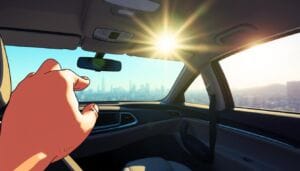
Tinted windows do four things well: they reject heat, block UV, cut glare, and add privacy. Drivers in DFW usually book tint for the heat rejection first, but the other benefits show up the day you drive away.
This post lays out the real advantages of window tint, what each one means in practice, and where the limits are. No hype, no fluff.
Table of Contents
ToggleHeat rejection
This is the headline benefit in Texas. A quality ceramic film blocks roughly 60 to 70 percent of solar heat coming through the glass. Carbon film blocks closer to 40 percent. Either is a real reduction.
What that means in practice is a cooler cabin when you get in. The dashboard does not bake. The steering wheel does not burn your hand. The AC catches up faster, which also means less load on the system.
In a Wylie summer where dashboard temps in a parked car climb past 150 degrees, this is not a minor benefit. It changes how the car feels every time you open the door.
UV protection
Quality tint blocks roughly 99 percent of UV across most products we install. UV is what fades dashboards, cracks leather, and contributes to the skin damage that comes from years of driving with sun on your arm.
The UV protection works at every shade, even very light films. A clear ceramic windshield film, which is barely visible, blocks the same 99 percent of UV as a darker film on the side windows. Drivers do not always realise UV protection is a function of the film, not the shade.
If you have leather seats or a dashboard you want to keep looking right, this benefit alone justifies the install.
Glare reduction
Glare is the benefit drivers notice the day they pick the car up. Headlights at night, low sun in the morning, white cars catching afternoon light, snow glare, all of it gets cut.
Drivers who commute east in the morning or west in the evening see the biggest day-to-day improvement. The strain on your eyes during a long drive into the sun drops noticeably with quality film, and a windshield strip across the top 5 inches catches the worst of the morning sun.
We do not market tint as a safety product, but the glare reduction is a real comfort and concentration benefit on long drives.
Privacy
A darker rear glass and rear sides keeps the inside of the car private. Bags on the back seat, gear in the cargo area, the kids in the booster seats, none of it is on display in a parking lot.
Texas allows any darkness on the back glass and rear side windows. Most drivers we install for go to 20 percent or 15 percent on the back, with 5 percent for full privacy. The front sides have to stay at 25 percent VLT or lighter by law.
The privacy benefit is partly about looks too. A clean, uniform tint job changes how the vehicle reads from outside.
Interior preservation
Tint extends the life of the interior. The combination of UV blocking and heat rejection slows down dashboard cracking, leather fading, and trim discoloration.
Cars that live outside in DFW sun without tint show interior wear within a few years. Tinted cars hold up much better. If you plan to keep the vehicle long term or you care about resale value, the interior protection is a real long-term advantage.
This is also why we recommend tinting the rear sides and back glass even if you have factory privacy glass. Factory privacy is a tinted glass, not a heat-rejecting film. It looks dark but does not block IR heat or UV the same way real ceramic film does.
Safety in the event of glass breakage
Tint film does not replace laminated glass, but it does hold tempered side glass together if it breaks. In a crash or a break-in attempt, the film keeps the shards in a sheet rather than spraying loose glass into the cabin.
This is a side benefit, not the main reason to install tint. But it is worth knowing about.
Comfort for passengers
If you have kids in the back seats, the heat reduction matters even more. Rear-facing car seats put babies right next to a side window taking direct sun. Tinted rear sides cut the heat hitting them, and the UV protection matters for skin that has had no chance to develop pigment.
Rear ceramic tint at 20 percent or darker is one of the most-asked-for installs for parents in DFW. The legal limit on the rear is wide open, so you can go as dark as you want there.
A consistent look
Cars with mismatched tint shades or a bare windshield against tinted sides look unfinished. A full vehicle install in a coordinated shade reads as intentional and clean.
If you have factory privacy glass, matching the front sides to the look of the back is the most common job we do. If you have clear factory glass all around, deciding on a uniform shade across the whole vehicle is the cleanest approach.
The shade we install most for a balanced look is 35 percent all around. The shade for a more aggressive look is 35 percent fronts with 20 percent rears.
Things tint will not do
To set expectations, here is what tint does not do.
It does not stop rock chips. That is paint protection film, which is a separate product.
It does not make the glass bulletproof.
It does not add structural strength to the vehicle. The film is too thin.
It does not survive being installed badly. The benefits all assume a proper install on prepped glass with quality film.
Brands and what they cost
We carry Llumar IRX and 3M Crystalline for ceramic. We use Suntek for carbon. The brand and shade affect the price.
Carbon tint, full vehicle: $250 to $375. Decent heat rejection, fair price, good for drivers on a budget.
Ceramic tint, full vehicle: $450 to $700. Strong IR rejection, long colour stability, our default in DFW heat.
Headlight tint: $100 to $200 per pair. Cosmetic add-on.
The number depends on the vehicle and the film, so a real quote needs a real look.
What we recommend for most drivers
Ceramic film, 35 percent on the front sides, 20 percent on the back glass and rears. Add a windshield strip if you commute into sun. Consider a clear ceramic windshield film if cabin temperature is your top priority.
For your specific car, come look at samples and talk through what you want. Stop by the Wylie shop or send us a message with your year, make, and model. We serve drivers across Wylie, Plano, Frisco, Allen, Garland, Rockwall, Murphy, Sachse, and Lavon.
*This article was drafted with the help of AI and reviewed by the Shell Shocked Wraps team.*
