

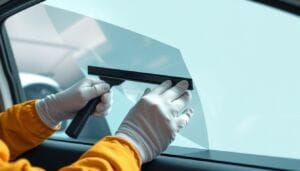
Quality window tint, installed correctly, will look as good in year seven as it does in year one if you take care of it. The maintenance is not complicated. It is a few simple habits and avoiding a few common mistakes that turn good film into hazy, peeling film before its time.
Here is how we tell every customer to care for their tint after pickup. The same advice applies whether the install was at our shop or somewhere else.
Table of Contents
ToggleThe first two weeks are about the cure
Right after install, the tint adhesive is curing. During this window, the film is fully attached but not at full strength. Anything that puts force or chemistry on the edges of the film during cure can cause damage that lasts for the life of the tint.
For the first three days: do not wash the car. Do not roll the windows down. Do not touch the inside of the glass.
From day three to day fourteen: hand washing only. Soft microfibre mitt, gentle car shampoo, no high pressure spray on the window edges.
After two weeks: normal wash routine is fine, but keep some habits going for the long term.
The cleaners that do not destroy your tint
Ammonia is the number one tint killer. The most common ammonia-containing product in a household is Windex original (the blue one). Spraying that on tinted windows breaks down the dye in dyed film and damages the protective top coats on ceramic film. Over months you get a purple haze, fading colour, and a shorter useful life.
Use ammonia-free glass cleaner. Most automotive-specific glass cleaners are ammonia-free. Read the label. Anything labelled “tint safe” or “ammonia free” works. A spray bottle of distilled water with a few drops of baby shampoo also works fine if you want a DIY option.
For the inside of the glass, spray cleaner onto the cloth, not directly onto the window. Spraying the window means cleaner runs down into the door panel and into the bottom seal of the glass, where it can wick up under the tint edge over time.
For the outside of the glass, treat it like the rest of the painted exterior. Hand wash with car shampoo, rinse, dry with a clean microfibre. The film on the inside is not exposed to the outside elements but the outside of the glass touches the same dust, road salt, and bug splatter as the rest of the car.
The cloths matter as much as the cleaner
Microfibre cloths only. Plush, low-pile microfibre for cleaning. Waffle weave microfibre for drying glass.
Paper towels are abrasive. They scratch tint over time even though they feel soft to the hand.
Old t-shirts are inconsistent. Some are fine. Some have polyester blends or pilling that scratches.
Squeegees are great for the outside of glass but not for tinted interior glass. Rubber blades drag on the tint top coat.
Wash microfibres separately from the rest of your laundry. No fabric softener (it leaves residue that streaks glass). Air dry or low heat.
Things to avoid that we see all the time
Stickers, decals, suction cup mounts on the inside of the tinted window. The adhesive on the back of these can pull the tint top coat off when removed. If you need to mount something inside, mount it to the dash or to the windshield (which is not tinted below the AS-1 line).
Pressure washing within four to six inches of the window edge. The high PSI can find its way under the film edge and start a lift. Pressure wash the body, hand wash the windows.
Automatic car washes with brushes. The brushes are abrasive and they hit the rolled-down channels of the windows where the tint edge sits. Touchless automatic washes are fine after the cure window. Hand washing is best.
Letting bird droppings or tree sap sit on the outside glass for days. Both are mildly acidic and can etch the glass surface. They do not damage the tint directly (the tint is on the inside) but they make the window look hazy from the outside.
Pets clawing at the inside of the window. We see this on cars where dogs ride in the back. The film top coat will scratch under sharp claws. Either crate the dog, use a seat cover that keeps them off the glass, or accept that the back side windows will need a redo eventually.
Smoking inside the car with the windows up. Tar from cigarette smoke builds up on the inside of glass over months. It is harder to clean off tinted glass than untreated glass because aggressive solvents are off the table.
What to do when you see a problem
Small bubbles in the first few weeks: normal. The cure is finishing. They almost always disappear on their own. Do not press them out with a tool. Wait.
Edge lifting after the cure window: call us. Catching it early means we can usually heat and reset the film. Letting dirt get under the lift means a redo of that pane.
Hazy or milky look that does not go away after a month: call us. Could be moisture trapped under the film, could be a defect in the install. We will look at it and tell you.
Purple or pink discolouration: that is dyed film failing. Time to replace. The dye in lower-grade film breaks down with UV. It is not repairable.
Visible scratches in the tint surface: usually from paper towels, ammonia cleaner, or pet claws. Cosmetic, not structural. The tint still works for heat and UV. Replace when you cannot live with the look anymore.
How long quality film should last
A quality ceramic tint, properly maintained, can hold up well for the life of most ownership cycles. We install Llumar IRX and 3M Crystalline ceramic, both with manufacturer warranties against the kind of failure (peeling, bubbling, colour shift) that comes from defective film rather than user damage.
A quality carbon tint, properly maintained, lasts a shorter time than ceramic but still measured in years. We install Suntek as our carbon option for customers who want a budget setup.
Cheaper dyed film fails faster. We do not install dyed film at our shop because the lifespan does not justify the savings. Most of the cheap deeply discounted tint jobs you see advertised are dyed film, and the colour shift that happens within a few years is not something most of those advertised warranties end up covering.
A few habits that add years
Park in shade or a garage when you can. Texas sun is hard on every surface in a car including tint. Time in shade is time the film is not under UV stress.
Keep a clean microfibre and tint-safe cleaner in the car. A quick wipe of dust or fingerprints once a week beats letting it build up.
Crack the windows on hot summer days when parked. Internal temperatures past 140 degrees stress the adhesive. A small amount of airflow keeps the cabin cooler.
Address tree sap, bird droppings, or bug splatter on the outside glass within a day or two, not a week. Acidic stains are easier to remove fresh.
If you have a coating on the rest of the car, you can use the same hand wash workflow. Tint and ceramic coatings get along well, the maintenance overlaps.
When to bring it back
If the tint is older and you are noticing the heat is not as well rejected as it used to be, or the colour is shifting, that is normal end-of-life behaviour. We can remove and re-tint the car. Removal of fully cured tint takes a few hours. Reinstall takes another 2 to 3 hours. Full vehicle ceramic re-tint runs $450 to $700.
If you are coming to us for the first time after years of self-care, we can take a look and tell you whether the tint is fine, has years left, or needs replacement.
We tint and care for cars across Wylie, Plano, Frisco, Allen, Garland, Rockwall, Murphy, Sachse, and Lavon. The maintenance advice is the same regardless of where the install came from.
Tint is a one-time install with a long-term payoff. The payoff comes from how you treat it.
*This article was drafted with the help of AI and reviewed by the Shell Shocked Wraps team.*
