

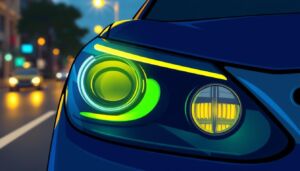
Headlight tint is a film over the headlight lens that changes the colour and look of the light. Done right, it adds a custom tone to the front end without breaking your visibility. Done wrong, it cuts your light output, fails inspection, and looks cheap.
If you are thinking about it, here is what to know before you put film on a working safety part of your car.
Table of Contents
ToggleWhat headlight tint actually is
A thin vinyl or PPF-style film applied over the outside of the headlight housing. Comes in shades from light smoke (subtle) through dark smoke (aggressive), plus colours like amber, yellow, and red.
It is not paint and it is not the same film as window tint. Headlight film is built to handle UV, heat, and bug strikes. The good versions also do not yellow over time, which the cheap stuff will.
We install headlight tint as a clean cut over the existing lens. No drilling, no glue, no permanent change to the housing. It can be removed later without damaging the headlight if you decide to revert.
The legal side
Texas law does not have a specific VLT minimum for headlight tint the way it does for window tint, but there is a general requirement that headlights remain visible from a set distance and produce white or amber light when on.
A light smoke tint on a modern LED housing will pass that bar. A dark smoke that essentially blacks out the light will not. If the headlight cannot be seen from 1,000 feet at night, you have an inspection problem and a safety problem.
We walk through the trade-off before installing. You can have the look or you can have full output, but past a certain darkness you cannot have both.
Light loss by shade
Approximate output reduction by film shade:
A halogen headlight at the dark end of that range becomes meaningfully unsafe at night on an unlit road. An LED with strong base output handles a darker tint better because there is more light to give up.
What we recommend by headlight type
Halogen housings. Stay light. Halogens already run dim by modern standards, and any meaningful tint pushes them past safe. Light smoke is the limit.
Projector LED housings. Can take a medium smoke without losing useful output, especially if the projector is well-aimed. Dark smoke is still aggressive.
Full LED bar housings. The headroom for darker tint is highest here because the base output is strong. Even so, we steer people away from full blackout on a primary driver.
Auxiliary or off-road lights. Different conversation. Tint film on dedicated off-road lights is a styling call and is allowed since those lights are not for street use anyway.
Headlight tint vs PPF for headlights
Two different products people sometimes confuse.
Headlight tint is a coloured film that changes the look of the lens. It also blocks some UV and provides a layer of physical protection.
Headlight PPF (paint protection film) is a clear film that protects the lens from rock chips, sand pitting, and UV yellowing. It does not change the look.
You can stack them. Clear PPF underneath, light tint on top. That gives chip protection plus a custom look. The cost adds up, but on a daily driver in DFW where the highways throw rocks at your front end constantly, headlight PPF earns its keep on its own.
Common shade choices
What we install most often:
Surface prep
Cheap headlight tint jobs fail because the prep was rushed. The lens has to be cleaned of road film, polished if there is haze, and dried fully before the film goes on. Any contamination underneath shows as a bubble or a peeling edge later.
We pull the headlights or mask carefully around them, do the prep, cut the film to the exact contour, heat-form it to the curve, and squeegee it down. Rushed installs miss the contour and leave finger-pulls along the edges.
How long it lasts
Quality headlight film runs 3 to 5 years on a daily driver in Texas sun before it starts to fade or yellow. A garaged vehicle gets longer. A car parked outside in DFW heat year-round trends toward the lower end.
When the film is ready to come off, it removes cleanly. The lens underneath should look the way it did when we put the film on, assuming the lens was sound at install.
What it costs
Headlight tint runs 100 to 200 dollars per pair, depending on the headlight size and complexity. Larger LED housings on trucks and SUVs cost more than compact sedan headlights. Add to that if you want clear PPF underneath.
We quote per vehicle. Send a picture of the headlight or bring the car by.
When we say no
We will turn down a job if the requested shade would make the vehicle unsafe at night. That is not a sales call, it is a liability and ethics call. If your daily driver has halogen headlights and you want full blackout, the answer is no, and we will explain why.
If you have aftermarket LED housings with strong output, the same dark tint conversation gets a yes more often. We talk through it case by case.
Care after install
Who this is for
Owners doing a wider styling project (wraps, blacked-out badges, smoked tail lights) who want the front end to match. Owners on chrome-trim cars who want to soften the look without painting parts. Anyone who wants to add a layer of physical protection to the lens at the same time.
If your only goal is keeping the headlight from chipping and yellowing, skip the tint and go clear PPF.
Booking
We tint headlights and tail lights for vehicles across Wylie, Plano, Frisco, Allen, Garland, Rockwall, Murphy, Sachse, and Lavon.
Call 972-439-1411, email ShellShockedWraps@gmail.com, or stop by 1143 Bozman Rd, Building 4-402 in Wylie. Tell us what you are driving and what shade you are after. We will quote it and walk through the safety side honestly.
This article was drafted with the help of AI and reviewed by the Shell Shocked Wraps team.
