

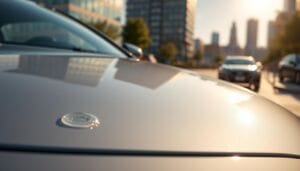
For anyone who plans to keep a vehicle more than two years and drives it on Texas highways, paint protection film on the front end is worth what it costs. For everyone else the answer is more nuanced and depends on the vehicle, the use case, and the budget.
Here is how we walk through the decision when someone asks.
Table of Contents
ToggleWhat PPF actually does
Paint protection film is a clear urethane sheet, around 8 thousandths of an inch thick, applied over the painted surface. It takes the rock chips, sand pitting, road tar, bug acid, and bird droppings that would otherwise hit the paint.
Modern PPF is self-healing. Light scratches and swirl marks vanish under sunlight or warm water. The film also blocks UV, which slows the rate at which clear coat fails on a vehicle parked outside in DFW year-round.
It is invisible from a normal viewing distance. People standing next to the car will not see it. The hood looks like factory paint, just better protected.
The case for PPF on the front end
DFW highways throw rocks. Limestone dust off the back roads near Rockwall pits paint over time. The combination of construction debris on 75 and 190, plus the long sun exposure most vehicles get sitting in lots all day, eats clear coat.
A front PPF kit covers the parts of the vehicle that take the worst of it: the leading edge of the hood, full front bumper, fender edges, headlights, and side mirrors. That is the 80 percent of the value of a full vehicle PPF for a fraction of the cost.
For a daily driver that lives on Texas highways and is being kept more than a couple of years, the front kit pays for itself by keeping the front end sharp and the resale clean.
The case for full vehicle PPF
Full body PPF wraps every painted panel. It is the most thorough protection available short of a metal cover.
The argument for it makes sense on:
The argument against it is cost. Full vehicle PPF runs in the 5,500 to 8,000 dollar range. For a daily driver where the rear panels almost never see chips, that money goes further as a front kit plus ceramic coating on the rest of the car.
What we install
We use XPEL Stealth and XPEL Ultimate Plus.
Ultimate Plus is the standard clear PPF. Self-healing, glossy finish that matches factory paint. The default for most cars.
Stealth is the same film with a satin matte finish. Goes over satin and matte factory paint to protect it. Also a popular look on gloss black or dark colours where owners want a stealth matte finish without committing to a full satin wrap.
Both films are top-tier. We do not install no-name PPF. The film is the cheap part of the job. Bad film fails in a season or two and the labour cost to remove and re-install is the same as doing it right the first time.
Cost ranges
Real numbers, vehicle-dependent.
Final number depends on the vehicle size, the panels covered, and whether the paint needs correction before the film goes on. We quote per vehicle, not from a flat price list.
How long PPF lasts
Quality PPF runs 7 to 10 years on a vehicle that is washed properly and not abused. UV degrades it, neglect degrades it, harsh chemicals degrade it. A vehicle that lives outside in DFW sun year-round will see closer to the lower end. A garaged car gets the upper end.
When the film is ready to come off, it removes cleanly. The paint underneath looks the way it did when we put the film on, assuming the paint was sound at install.
PPF vs ceramic coating
Different products that solve different problems.
PPF is a physical film that takes physical impact. Rocks bounce off it. Bug acid sits on the film, not on the paint. The clear coat underneath is mechanically protected.
Ceramic coating is a chemical layer that bonds to the clear coat and adds gloss, hydrophobic behaviour, and chemical resistance. It does not stop a rock chip. It makes the surface easier to wash and harder for contaminants to bond to.
The full answer for a high-value daily driver in Texas is both. PPF on the front end where rocks hit, ceramic coating on every painted panel for the wash and chemical resistance benefit. They stack and complement each other.
If you only have budget for one, PPF on the front beats ceramic everywhere for a vehicle that drives Texas highways. Ceramic everywhere beats PPF on the front for a garage queen.
When PPF is not worth it
A few cases where we tell people to skip it or scale it back.
For those cases, the money is better spent elsewhere or saved entirely.
What “self-healing” actually means
Modern PPF has a top layer that flows back into shape under heat. A swirl mark from a wash mitt vanishes under the sun in an hour or two. A light scratch from a fingernail vanishes faster.
It does not heal a deep cut, a tear, or anything that goes through the urethane layer. Self-healing means surface scratches, not impact damage. That is still meaningful, those surface marks are what makes a hood look tired after three years of washing.
How long the install takes
A front PPF kit takes 1 to 2 days from drop-off to pick-up depending on the vehicle. The film has to be cut to the panel, lifted, slip-solutioned, squeegeed flat, and given time to bond. We pull badges and emblems where it makes sense for a cleaner finish.
Full vehicle PPF takes 4 to 7 days. There is a lot of film to cut and a lot of edges to wrap.
Care after install
Our recommendation
For a daily driver in DFW kept more than two years, install a full front PPF kit. That is the sweet spot of cost vs benefit and it protects the panels most likely to take damage.
For a high-value or long-term keeper, full vehicle PPF makes sense. For everything else, save the money.
Want a real number for your vehicle? Call 972-439-1411 or stop by the shop in Wylie. We will look at the panels, walk through what makes sense, and quote it.
This article was drafted with the help of AI and reviewed by the Shell Shocked Wraps team.
