

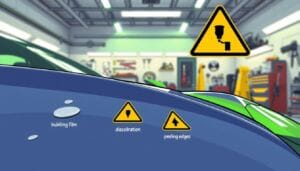
Paint protection film is doing its job when you stop noticing it. The signs that PPF needs attention show up at the edges first, in the gloss second, and in the way the film handles a wash third. We install XPEL Stealth and XPEL Ultimate Plus at our Wylie shop, and these are the warning signs we tell every customer to watch for.
PPF is not permanent. A quality install on a daily driver in Texas will hold up for a long stretch, but heat, hail, road grit, and time will eventually take a toll. Catching wear early lets you address the affected panel before the film fails in a way that brings the paint underneath with it.
Table of Contents
ToggleLifting at the edges
The first place to look is every edge where the film terminates. Hood edges. Around mirrors. The line above a wheel arch. Around door handles.
A small lift at an edge is normal in the first few days after install while the film fully cures. A lift that has been there for weeks or that is growing is not. Once an edge starts to peel back, dirt gets under it, the adhesive contaminates, and the lift accelerates.
If you see an edge that has come away, do not pull on it. Bring it in. We can usually re-tuck and re-seal an early lift before it spreads.
Yellowing or hazing
Older or lower quality films yellow over time as the topcoat oxidises. Modern self-healing films from XPEL are formulated to resist this, but no film is immune to UV forever, and Texas sun is unforgiving.
A subtle yellow tint that shows up most clearly on a white car is the first stage. A film that has gone visibly amber against the paint colour is at the end of its useful life. At that point the film is doing more harm than good aesthetically, and the topcoat is no longer fully protecting the layer below it.
Yellowing is one of the clearest signals that a panel is due for replacement.
Cracks or splits
PPF can develop cracks. The most common cause is impact, where a rock or debris hit the film hard enough to crack the topcoat without fully tearing through.
Cracks are bad because they let water and contaminants reach the adhesive. Once that starts, the film around the crack will start to lift or discolour.
A single small crack from a rock chip can usually be left alone if it is in a low-stress area. Multiple cracks across a panel, or a crack in a high-flex area like a hood lip, mean the film needs to be replaced on that panel.
Loss of self-healing
Modern PPF self-heals minor swirl marks and wash marring with heat. Park a self-healing film in the sun for an hour and most of the small marks lift out.
When the self-healing stops working, the film is at the end of its useful life. The topcoat has degraded enough that it can no longer rebound. Swirls and water spots start to accumulate and stay.
This is a slow change and easy to miss. If you wash a coated and filmed car and the film looks visibly different from the bare paint after the wash, that is a clue.
Staining that will not come off
Bird droppings, tree sap, bug splatter, and brake dust are the four worst offenders for staining PPF. A fresh film with a healthy topcoat will release these contaminants with a normal wash. An older film will hold the stain.
If you see ghost marks or shadows on the film that do not come out with a thorough wash and a decon spray, the film has been compromised at the surface.
Staining alone is not always a reason to replace. It is a reason to step up your wash routine, address contaminants quickly, and start planning for a refresh.
Bubbles or pockets under the film
A correctly installed PPF should be free of any bubbles or pockets after the cure. If you see a new bubble or a pocket form on a film that has been on the car for years, water has gotten under the film, often through a crack, an unsealed edge, or an aging adhesive layer.
Small bubbles can sometimes be addressed by an installer with a heat gun and a syringe. Larger pockets usually mean replacement on that panel.
Adhesive failure on a corner
When the adhesive starts to fail, the film does not lift uniformly. It softens at a corner, lets in dirt, and creates a section that looks slightly cloudy or off-colour against the rest of the panel.
This is most common on hood edges and on the leading edge of the bumper, where the film takes the most direct sun and the most direct road heat.
Adhesive failure is a clock running. The film will keep coming up over weeks and months until it lets go.
What we do during a PPF inspection
When you bring a vehicle in, we wash it, dry it, and walk every panel. We check edges, look for yellowing under raking light, test self-healing on a small area with a heat source, and check for bubbles or pockets along the film seams.
The output is panel by panel. Some panels might be in great shape and need no attention. Others might need a re-tuck. A panel with cracks or yellowing might be due for replacement.
A full PPF replacement is a bigger job than a single panel refresh, and we usually do not push customers to redo the whole car when only the front bumper or hood is showing wear.
How long PPF lasts in Texas
Manufacturer durability claims are based on ideal conditions. Texas is not ideal conditions.
A pro-installed film like XPEL Stealth or XPEL Ultimate Plus on a daily driver in DFW heat will hold up well for years before showing any of the warning signs above. A garaged car can run longer. A car parked outside in full sun will hit the warning signs sooner, especially on the hood and roof.
Wash technique extends the life. Two-bucket method, pH-neutral soap, soft mitts, no automatic brush washes.
Pricing for refresh and replacement
Pricing depends on which panels need work, how much existing film needs to come off, and whether you are stepping up to a different XPEL tier.
As ballpark ranges, a full front PPF runs $1,800 to $2,500. A full vehicle PPF runs $5,500 to $8,000. Single panel work is quoted per job.
Send us photos of the panels you are concerned about and we can give you a real number.
Where we work
Our Wylie shop covers Plano, Frisco, Allen, Garland, Rockwall, Murphy, Sachse, and Lavon for PPF inspection, refresh, and full replacement.
*This article was drafted with the help of AI and reviewed by the Shell Shocked Wraps team.*
