

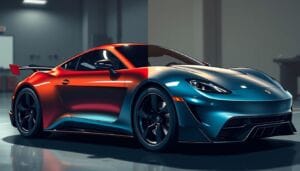
Short answer first. If your goal is paint protection, get PPF. If your goal is changing the look of the car, get a vinyl wrap.
They are not the same product trying to do the same job. One protects, one decorates. The wrap that turns your silver SUV satin black is vinyl. The film that stops a rock from chipping your bumper is PPF.
We install both at our Wylie shop, and the question we get most often is which one to spend on. Here is how we think about it.
Table of Contents
ToggleWhat vinyl wrap actually is
Vinyl wrap is a coloured or printed adhesive film. We carry 3M 2080 and Avery SW900 because both lay down clean, hold colour in Texas sun, and pull off without tearing the paint underneath when it is time to remove. The film is roughly the thickness of a thick sticker. It covers the panel in colour. Gloss, matte, satin, chrome, brushed metal, colour-shift, you can have any of it.
The protection vinyl gives you is real but limited. It will save your clear coat from light scratches, bird droppings, and minor scuffs. It will not stop a rock chip. A pebble at highway speed punches through vinyl the same way it punches through paint.
What vinyl is genuinely good at is changing the appearance of the vehicle without the permanence and cost of a respray. You can run satin black for two years, peel it, and your factory paint is sitting there underneath waiting for you.
What paint protection film is
PPF is a clear urethane film. We install XPEL Stealth and XPEL Ultimate Plus depending on whether you want the matte finish or the gloss. The film is thicker than vinyl and engineered for impact.
Rocks bounce off it. Bug acid does not eat through it. Modern PPFs self-heal, meaning a swirl mark or a fingernail scratch closes itself when the panel warms in the sun.
PPF does not change the look of your car. That is the point. It goes on clear and the factory paint shows through. With Stealth you get a satin finish overlaid on glossy paint, which is the trick that makes a glossy car look matte without committing.
For chip protection, PPF is the only real answer. Vinyl is not in the same category.
When vinyl wrap wins
Vinyl wins when the goal is the look. Three scenarios where we steer people toward vinyl over PPF.
You want to change the colour. PPF cannot do that, vinyl can. A full colour change wrap on a sedan runs in the $2,800 to $4,000 range at our shop, and the exact number depends on the vehicle, the colour you want, and the condition of the paint underneath.
You want a finish your factory does not offer. Satin black on a car that came from the dealer in pearl white. Chrome. Brushed aluminum. Colour-shift. None of those finishes exist as paint options on most vehicles, and vinyl is how you get them without a custom respray.
You are running a commercial vehicle. Logo, colours, contact details, full panel coverage. Commercial wraps run $1,800 to $5,000 depending on the truck or van and how much of it gets covered. PPF on a work truck makes no sense. Vinyl is the right tool.
When PPF wins
PPF wins when the goal is keeping the paint underneath in showroom condition.
You drive on highways and your front bumper, hood, and mirrors take rock chips. A front PPF kit at our shop runs $1,800 to $2,500 depending on the vehicle. It covers the high-impact panels and stops rocks from reaching the paint. For most cars this is the right level of coverage and it pays for itself the first time it eats a rock you would have otherwise had touched up.
You bought a new car and want to keep it new. Full vehicle PPF runs $5,500 to $8,000 in our shop, depending on the vehicle. That is real money, and we do not push it on every buyer. For most daily drivers in DFW the front kit is enough. If you drive a Porsche or anything where a paint repair is going to cost you four figures per panel, full PPF starts to make sense.
You want self-healing. Modern PPFs close minor scratches when warmed by the sun. Vinyl does not.
What vinyl and PPF have in common
Both films go over your existing paint. Both are removable, with PPF being a bigger job to take off than vinyl. Both need a clean, decontaminated surface before install, which is why prep takes longer than people expect. A full wrap or full PPF is a 3 to 5 day job in the shop, not same-day work.
Both films have a finite life. Vinyl in the Texas sun lasts 5 to 7 years if it is a quality film and the install is clean. PPF lasts longer, often 10 years or more, because the urethane is engineered for outdoor weather. Either film fails faster if you neglect it.
Cost: what you are actually paying for
Cost differences come down to material and labour. Vinyl is the cheaper material. PPF is the more expensive material.
Labour for both is similar because the install process is similar. Stretching, heating, squeegeeing, trimming, post-heating to lock the adhesive. PPF is more demanding because the film is thicker and less forgiving, and a bad PPF install shows up as silver lines along the edges where the film lifted.
Ranges at our shop:
Every quote depends on the vehicle, the panels, the condition of the paint, and the film you want. Send us photos and we will give you a real number.
How they hold up to Texas weather
DFW summers run 95 to 105 in the sun, and that heat matters for both films. UV exposure is the long-term killer for vinyl. A cheap vinyl on a daily-driven car parked outdoors will fade and start to lift at the edges in a few years. A quality vinyl from 3M or Avery, installed clean, holds up well. Garage-kept cars do better than outdoor cars on every film.
Hail season in spring is another factor. Neither vinyl nor PPF stops hail. PPF will absorb light hail dings on flat panels better than bare paint, but a serious storm dents through both. If you are buying paint protection thinking it is hail protection, it is not.
Limestone road dust around the Wylie and Rockwall area dirties up vinyl faster than glossy paint because matte finishes hold dust visibly. Worth knowing if you are wrapping satin and parking outside.
Which one we recommend
Want to protect your paint? PPF, almost always a front kit unless you are buying a high-value vehicle you plan to keep long term.
Want your car to look different? Vinyl.
Want both? We install PPF first on the high-impact panels, then vinyl over the rest. PPF goes under vinyl, never the other way around. That is the order.
The mistake we see most is people buying vinyl thinking it will save their paint from rocks. It will not. If you are spending $3,000 to wrap your car for protection, you are spending it on the wrong product. Spend that on a front PPF kit and you are getting the protection you actually wanted.
Common questions
Will vinyl damage my paint? No, if it is installed and removed properly. Quality vinyl on healthy factory paint comes off clean. Vinyl on resprayed paint can lift the respray, which is a paint problem not a vinyl problem.
Can you put PPF over a wrap? No. PPF needs to bond directly to the paint or the clear coat. Vinyl underneath defeats the bond.
How long do you need the car for? Full wrap or full PPF, plan on 3 to 5 days. Front PPF kit, 1 to 2 days. Same-day jobs are rare for either product if you want it done right.
Do you do mobile installs? No. Both films need a controlled environment, dust-free, climate-controlled. Doing this in a driveway gets you a bad install.
We service Wylie, Plano, Frisco, Allen, Garland, Rockwall, Murphy, Sachse, and Lavon. Send us your vehicle details and we will quote either film and tell you which one is right for what you are trying to do.
*This article was drafted with the help of AI and reviewed by the Shell Shocked Wraps team.*
