

Window tint has been around long enough that the myths about it have outlived the products they were based on. We hear the same handful of bad assumptions every week at the shop, and most of them come from old film that nobody installs anymore.
Below are the tint myths that come up most often, and what is actually true.
Table of Contents
ToggleMyth 1: Tint will bubble and turn purple
This was true for cheap dyed film made decades ago. The dyes broke down under UV, the adhesive failed, and the result was the bubbled, purple back glass you have probably seen on an old beater.
Modern carbon and ceramic films do not use the same dye chemistry. Carbon film is colour stable for years. Ceramic film is even more stable because the metal-free ceramic particles do not fade the way dyes do. We install Llumar IRX, 3M Crystalline, and Suntek carbon, and none of these turn purple.
If you see a purple car on the road, you are looking at film that was either old, the wrong product, or installed badly. It is not the standard anymore.
Myth 2: Tint blocks visibility at night
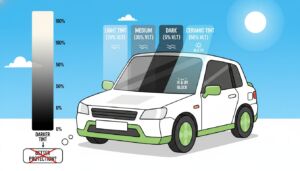
A 35 percent tint, the most common shade we install on front sides, lets 35 percent of light through. That is plenty for night driving on lit roads.
Where this myth has truth in it is the very dark shades. A 5 percent or 15 percent on front side windows would noticeably reduce visibility at night, especially in fog or rain. That is also why Texas does not allow front side windows darker than 25 percent VLT.
We default to 35 percent on the fronts because it gives you a meaningful heat and glare reduction without darkening the view. If you want darker on the back glass and rear sides, that is allowed in Texas at any shade.
Myth 3: All tint is illegal
Texas tint law is specific, and most of what we install is legal. The rules are:
What gets drivers in trouble is going darker than 25 percent on the front sides. The standard 35 percent we recommend clears the legal margin with room to spare.
Myth 4: Tint is only about looks
The cosmetic side of tint is the most visible part, but it is not the main reason most of our customers book it. Heat rejection is.
Texas summers send dashboard temperatures past 150 degrees in a parked car. A ceramic film cuts the solar heat coming through the glass by roughly 60 to 70 percent depending on shade. That is the difference between burning your hand on the steering wheel and not.
Tint also blocks UV. Most quality film blocks 99 percent of UV. That matters for the skin damage that comes from years of driving with sun on your arm, and it matters for the dashboard, leather, and trim that fade and crack from UV exposure.
Glare reduction is the third reason, and the one drivers notice the day they pick the car up. Headlights at night, low sun in the morning, reflections off other cars in the afternoon, all of it gets cut down.
Myth 5: Ceramic and carbon are the same, the brand is just charging more
This is the one we have to explain almost every quote.
Carbon film uses carbon particles to block heat and look black. It is colour stable, looks great, and rejects roughly 40 percent of solar heat depending on shade. It is the entry point for serious tint.
Ceramic film uses non-conductive ceramic particles that block infrared heat at a much higher rate. The IR rejection on ceramic film like Llumar IRX or 3M Crystalline lands closer to 60 to 70 percent of solar heat. That is a real, feelable difference in cabin temperature.
Ceramic also does not interfere with cell signal, GPS, or radio the way old metallic film could. Carbon does not interfere either. The films are not the same product at the same price.
Myth 6: Tint will damage the defroster lines
Properly installed tint goes over the defroster lines without breaking them. The film is applied to the inside of the glass, so the lines stay sealed underneath.
What can damage defroster lines is bad tint removal. Steaming the film off and then scraping aggressively can lift the lines off with the adhesive. We have removed enough old tint to know which methods are safe and which are not. If your defroster works before, it should work after.
Myth 7: You can tint your car at home with a kit
You can. The result will tell you why people pay a shop instead.
Glass is curved. Film does not stretch evenly across a curved surface unless you heat-shrink it correctly. Dust is everywhere. Even a clean garage has enough particles in the air to land between the film and the glass during install.
The most common failures we see in DIY tint are bubbles trapped under the film, peeling edges, fingers and creases, and shrinkage on rear glass. We get DIY removal jobs often enough to know that the cost of fixing it usually exceeds the cost of having the shop do it the first time.
Myth 8: Tint voids your factory glass warranty
It does not. Tint is applied to the inside of the glass and can be removed without affecting the glass itself. Factory glass warranties cover the glass, not the film on it.
The warranty that matters with tint is the manufacturer warranty on the film. Llumar, 3M, and Suntek back their products. We back our installation. The two together are what you want when something needs to be sorted out down the road.
Myth 9: Darker is always better for heat rejection
Shade and heat rejection are not the same thing. Heat rejection comes from the film’s IR rejection rating, not how dark the shade looks.
A high quality ceramic film at 50 percent VLT, which looks fairly light, can reject more solar heat than a cheap dyed film at 5 percent. Drivers see a dark window and assume it is doing the work. The IR rejection is what does the work.
If you want the most heat rejection without going dark, ceramic at 50 percent on front sides is a strong choice and well within the legal limit.
What we recommend
For most daily drivers in DFW, our default is ceramic at 35 percent on the front sides and 20 percent or darker on the back glass and rears. That setup gives strong heat rejection, full UV protection, glare reduction, and stays legal on the front.
If you are weighing carbon vs ceramic, the rule of thumb is simple. If you park outside in the sun often or you have leather that you want to protect, the upgrade to ceramic pays you back. If your car lives in a garage and the heat is less of a daily issue, carbon is honest film at a lower price.
For your specific car, the only real answer is to look at samples and talk through what you actually want from the install. Stop by the Wylie shop or send a message with your year, make, and model.
*This article was drafted with the help of AI and reviewed by the Shell Shocked Wraps team.*
