

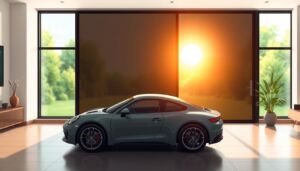
Privacy from window tint comes down to two things: how dark the film is, and how the light is hitting the glass. A 5 percent VLT film blocks almost all view in during the day. The same film at night, with your dome light on, makes the inside of the cabin perfectly visible from the parking lot.
That paradox surprises a lot of people. So before we talk about what film to put on your car for privacy, we need to talk about how privacy actually works through tinted glass.
Table of Contents
ToggleThe day and night problem
Tinted windows reflect more light back than they let through. During daylight, the outside is brighter than the inside of your car, so when somebody looks at your window from outside, they mostly see a reflection of the parking lot. Your interior stays hidden.
At night, that flips. The inside of your car (with dome lights, dashboard glow, or a phone screen) becomes brighter than the outside. Now the glass shows what is inside, not what is reflecting off it.
This is true at every tint level. A 50 percent film hides almost nothing during the day. A 5 percent film hides almost everything during the day. But at night, both films expose anything lit up inside the cabin.
The takeaway is that tint gives you daytime privacy. For real night privacy, you need to limit interior light or move to physical solutions like sun shades.
What the law lets you do for privacy
In Texas, the front side windows have a 25 percent VLT minimum. That sets the floor on how dark you can go on the driver and front passenger windows.
Rear side windows and the back glass: any darkness allowed. This is where the real privacy comes from on most vehicles, since the back of the car is where rear seat passengers, cargo, kids, and pets sit.
Windshield: only the top 5 inches can be tinted (any darkness in that strip). The rest of the windshield must be clear.
For privacy purposes, almost everyone goes darker on the back than on the front. A typical privacy-focused setup is 25 to 35 percent on the front sides (legal limit, looks balanced) and 5 to 20 percent on the rears.
Tint levels and what they actually hide
Here is what each VLT range looks like in real life.
50 percent VLT: very light tint. Mostly heat rejection and UV protection. Almost no daytime privacy. Most factory privacy glass on minivans and SUVs is around this level.
35 percent VLT: medium-light tint. You can still see through it pretty clearly from outside. Light privacy. Legal on the front sides in Texas.
25 to 30 percent VLT: medium tint. The front of the cabin starts to look obscured from outside during the day. The legal limit on front sides.
20 percent VLT: medium-dark tint. Reasonable daytime privacy on the rear. You can still see large shapes inside but not faces or details.
15 percent VLT: dark tint. Strong daytime privacy. Hard to see anything inside during the day.
5 percent VLT (limo tint): nearly opaque from outside during the day. Maximum daytime privacy. Common on the back of SUVs and trucks.
Almost every privacy-focused car we tint ends up at 5 or 15 percent on the back, with the legal max on the front.
Reflective and one-way films
People ask about one-way mirror films. They exist. In Texas, the front side windows are capped at 25 percent reflectivity, so you cannot install heavily reflective film on the driver and passenger windows. We do not stock high-reflectivity automotive film for this reason.
Reflective film also has practical downsides. It can make your car a beacon for parking lot attention, it can interfere with cell phone signals if it has a metallic layer, and it does not solve the night problem at all.
For real automotive privacy, dark non-reflective film on the back is more effective and looks better.
Frosted, decorative, and blackout films
These are common in residential and commercial buildings, where you want to obscure a bathroom window or a conference room. We do not install window film for buildings. We are an automotive shop only.
For automotive applications, frosted film is rarely used. The glass shape is curved, the film does not work the same way on car glass, and frosted film blocks too much light to be safe in a moving vehicle.
If you want maximum privacy in a parked vehicle, the right tool is a sun shade for the windshield and side windows. Tint plus sun shades when parked is the most private setup short of having no glass.
What we actually recommend for privacy
For most customers asking specifically about privacy, the setup that works is straightforward.
Front sides: 25 to 35 percent VLT ceramic. Legal in Texas, blocks daytime visibility into the front cabin without making nighttime driving harder than it needs to be.
Rear sides and back glass: 5 to 15 percent VLT ceramic. Strong daytime privacy on the rear. Looks clean from outside.
Ceramic film for both. We install Llumar IRX and 3M Crystalline ceramic. Ceramic blocks more heat at the same VLT than carbon or dyed film, so you get privacy and a cooler cabin together.
Full vehicle ceramic tint at our shop is $450 to $700 depending on the vehicle. Carbon is $250 to $375 if you want a budget option. Both legal, both private at the right VLT, ceramic just performs better in the heat.
Install time is 2 to 3 hours for most vehicles. After install, you wait three days before washing the car, and two weeks before any high pressure washing or automatic car wash.
When tint privacy is not enough
If you regularly leave valuables in your car visible from outside, tint helps but it does not eliminate the risk. Anybody who walks up to the window with their face against the glass and a hand cupped around their eyes can see in even through 5 percent film. Tint discourages casual looking, not determined looking.
If you have to leave a laptop or a bag in the car, putting it in the trunk or under a seat does more than any tint job will.
If your concern is being followed or observed, tint on the rear sides and back glass is the strongest legal setup. Tint on the front sides is limited by the 25 percent rule, but legal ceramic still does meaningful work during daylight.
Heat and UV are the bonus benefits
Tint is sold as a privacy product but for most of our DFW customers, the bigger value is heat rejection and UV protection. A south-facing windshield in a Wylie parking lot in July hits 140 degrees inside the cabin. Quality ceramic tint pulls that down by a meaningful margin.
UV protection is also real. Texas sun fades dashboards, leather seats, and door panels. Ceramic film blocks more than 99 percent of UV at any VLT, including light tint. So the lightest legal tint on the front gives you real UV protection without darkening the glass.
Get tint sized for your privacy and your daily driving
We tint cars across Wylie, Plano, Frisco, Allen, Garland, and Rockwall. If privacy is the main reason you want tint, tell us when you call. We will set the front to legal ceramic and the back to whatever level matches the privacy you want, and we will meter the car after install so you know the numbers are right.
If you want to come look at sample squares in different VLTs against your own glass, the showroom has them. The right number is easier to pick when you can see it on a real window in the Wylie sunlight.
*This article was drafted with the help of AI and reviewed by the Shell Shocked Wraps team.*
