

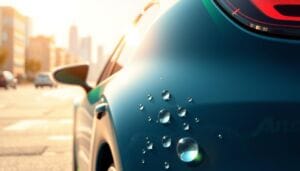
A hydrophobic surface repels water. On a car, that means rain, hose water, and wash water bead up and roll off instead of soaking in or sheeting flat across the panel. The bead is the visible proof that the surface is doing its job.
That is the headline. The practical effects on a daily driver in DFW go further than just a cool-looking water bead.
Table of Contents
ToggleThe science in one paragraph
Water has surface tension. On a clean glass or paint surface, water spreads out in a sheet because it bonds to the surface molecules. A hydrophobic coating raises the surface energy so water cannot bond to it. The water pulls itself into a tight ball instead, and gravity rolls it off.
The technical measurement is called contact angle. A flat sheet of water has a contact angle near zero degrees. A perfect bead has a contact angle near 180 degrees. A modern ceramic coating gets the contact angle into the 100 to 120 degree range, which is what gives you those tight beads you see in product videos.
What hydrophobic actually does for the vehicle
The bead is fun to look at. The benefits behind it are what you are actually paying for.
Self-cleaning effect. When water rolls off a hydrophobic surface, it picks up dirt, dust, and pollen on the way down. The car still gets dirty over time, but a rainy day on a coated car leaves it cleaner than a sunny day, which is the opposite of how an uncoated car behaves.
Less water spotting. Water spots are mineral deposits left behind when water evaporates on a panel. Less water sitting on the panel means fewer spots. Hard water in DFW is real and water spots are a constant fight, so this matters here more than in some climates.
Easier washes. Dirt does not bond as tightly to a hydrophobic surface. Bug splatter, road tar, brake dust, all of it comes off with less mechanical pressure during a wash. That means less micro-marring from the wash mitt, which means the paint stays glossier longer.
Less bird dropping etching. A bird dropping that lands on a hydrophobic surface sits more on top of the coating instead of starting to bond with the clear coat underneath. You still need to wipe it off the same day, but you have a wider window before it etches.
Where you find hydrophobic surfaces on a car
Three main places.
Ceramic coating on the paint. This is the big one. Gtechniq, CQuartz, System X, all the major coating brands sell their hydrophobic behaviour as a top feature. We install all three across multiple package levels.
Glass coating on the windshield. A separate product, applied to the windshield and side glass. The coating is what gives you the effect of rain rolling off the windshield without the wipers, especially above 35 mph. Worth doing for any daily driver who deals with regular rain.
Wheel and trim coatings. Different formulations than paint coatings, designed to resist brake dust and road grime on wheels, and the chemicals used to dress plastic trim. Optional add-on with most of our coating packages.
What hydrophobic does not do
This is where customer expectations get out of line with what the coating can actually deliver.
A hydrophobic coating is not a substitute for paint protection film. PPF is a thick urethane film that takes rock chip impacts and absorbs them. A coating is a microns-thick layer that does not stop a chip. We see people skip PPF because they got a coating, then we see the same people back for chip repair a year later.
A coating is not scratch-proof. The marketing pitches “9H hardness” and similar numbers, but the test those numbers come from is for thin films and does not translate to real-world rock impact or wash damage. A dirty wash mitt will still mar a coated panel.
A coating does not prevent paint fading on a car that lives outside in DFW summer for 10 years. It slows it. UV protection is part of what most coatings do, but the protection is not absolute and the coating itself wears down over time.
How long the hydrophobic effect lasts
Different coatings have different lifespans. The hydrophobic behaviour weakens before the coating itself fails.
A 1 to 3 year coating typically holds strong beading for the first year, weaker beading in year two, and basically flat by year three even though the coating is still on the panel. A 5 to 7 year coating holds strong beading 3 to 4 years before it starts thinning out.
The fix is a maintenance topper from the same brand. A spray topper applied during a wash refreshes the surface and brings the beading back close to fresh for a few months at a time.
Hydrophobic vs hydrophilic vs hydroneutral
You will see all three terms in coating product marketing.
Hydrophobic repels water into beads. Most consumer coatings.
Hydrophilic is the opposite, water sheets flat across the surface. Rare in automotive, more common on glass coatings designed to keep water from beading on a windshield where beads might distort vision.
Hydroneutral is a middle ground. Water flows off as a thin film without beading. Some industrial and commercial coatings use this approach.
For a normal daily driver, hydrophobic is the right call. The tight beading is what you want on paint panels.
Is the bead a real measure of coating health
Not exactly. The bead is a proxy. It tells you the surface is still hydrophobic, which usually means the coating is still working, but a strong bead does not guarantee the coating is protecting against UV or chemical etching the way it did when fresh.
We use beading as a quick check during service appointments. A coated car that comes in with poor beading gets a top-up recommendation. A coated car with strong beading is generally fine.
Our take
A hydrophobic ceramic coating is the right call for any car that lives outside in DFW. The water spot reduction alone earns the cost in our hard water. The easier wash routine extends the life of your paint by reducing the wash damage that adds up over the years.
It is not a replacement for PPF. The two products do different jobs. A daily driver in this region with the budget for both gets the most protection out of PPF on the front end and a ceramic coating over the rest of the car.
Bring the vehicle by and we will tell you which package fits the use case.
*This article was drafted with the help of AI and reviewed by the Shell Shocked Wraps team.*
