

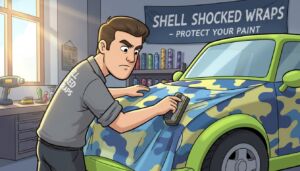
A vinyl wrap installed on healthy factory paint will not damage that paint. A vinyl wrap installed on bad paint, removed badly, or left on for years past its design life can pull lacquer or leave residue. The variable is the paint condition and the install, not the wrap itself.
We are Shell Shocked Wraps in Wylie, Texas. We install 3M 2080 and Avery SW900 vinyl daily, and the paint damage worry is the most common question on the phone.
Table of Contents
ToggleWhat “factory paint in good condition” actually means
Healthy paint that handles a wrap and a clean removal has three things going for it.
It is the original factory clear coat, sprayed and baked at the assembly line. Factory clear is harder and bonds better to the colour layer than aftermarket repaints.
It has not been touched up with rattle can or unprimed body filler. Aftermarket paint that did not cure properly will lift with the vinyl when the film comes off.
It is not flaking, oxidised, or already lifting. If clear coat failure is already showing as cloudy patches or peeling edges, vinyl will accelerate the failure when removed.
If the paint passes those three filters, a wrap goes on and comes off without leaving the panel worse than before.
Where damage actually comes from
The cases where vinyl pulls paint usually trace back to one of four causes.
Aftermarket repaint with poor adhesion. A car that was resprayed cheaply, or a panel that was repaired after a collision and not properly prepped, can have a clear coat that is not fully bonded. Vinyl adhesive grabs the loose layer and pulls it on removal.
Original paint with existing clear coat failure. Sun damaged hoods and roofs on older vehicles in Texas often have invisible micro lifting in the clear. Vinyl can finish that lifting on removal.
Vinyl left on too far past its design life. Cast vinyl is rated for around 5 to 7 years. Past that the adhesive cures hard and the film becomes brittle. Pulling old vinyl off a panel that has baked in DFW sun for a decade is a different job than pulling a 2 year old wrap.
Wrong removal technique. Cold vinyl pulled at a sharp angle without heat is the most common cause of paint damage. Heat softens the adhesive and lets the film release cleanly.
We tell people the wrap is not the risk. The condition of the panel and the way the film comes off are the risks.
How a proper install protects the paint
A real install protects the paint in ways that get skipped on cheap jobs.
A wrap installed this way actually protects the paint underneath. UV does not reach the colour layer. Highway grit hits the vinyl, not the clear. Bug splatter that would etch unprotected paint sits on top of a film that gets washed off with no consequence.
How a proper removal protects the paint
Removal is where most paint damage stories come from. Done right, it looks like this.
Done this way on factory paint, you cannot tell a wrap was ever there.
Real prices and timelines
Final number depends on the vehicle and the condition.
We will quote your specific car after a phone call.
Texas heat as the wrap accelerator
DFW summer pushes pavement temperature past 140 degrees, which matters for vinyl in two ways.
Cure happens faster after install, which is good. The film locks down within a week instead of two.
Adhesive bond gets harder over years, which matters at removal. A wrap that lived through five DFW summers comes off with more effort than the same wrap that lived in a garage in a cooler climate. We plan for that on removal jobs.
When a wrap is not the right product
If your goal is rock chip protection on the front of the car, vinyl is the wrong product. Vinyl is colour and graphics. Paint protection film is what you want for impact resistance.
We install XPEL Stealth and XPEL Ultimate Plus for PPF. Real ranges:
If you want both colour change and chip protection, vinyl over PPF is the order, with the PPF going on first. We do that combo, and it is the right way to layer the products.
Service area
We wrap and protect cars in Wylie, Plano, Frisco, Allen, Garland, Rockwall, Murphy, Sachse, and Lavon. Call us with the vehicle, the year, and the goal, and we will tell you straight whether a wrap, PPF, or both is the right call.
This article was drafted with the help of AI and reviewed by the Shell Shocked Wraps team.
