

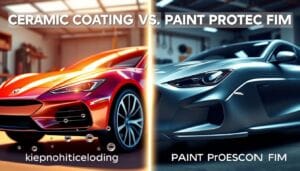
If you have to pick one, paint protection film protects your paint better than ceramic coating. PPF physically blocks rock chips, scratches, and impact damage that ceramic coating cannot stop. Ceramic coating still has its place for chemical and UV protection, but on the question of which one shields the paint from real road damage, PPF wins.
That answer changes a bit depending on the car, the budget, and how it gets driven. The rest of this post breaks down how each one works, where each one wins, what they cost, and what we recommend in the shop for different setups.
Table of Contents
ToggleHow PPF works
Paint protection film is a clear thermoplastic urethane layer that bonds to the painted surface of the vehicle. It is roughly 8 mils thick on most products, which is thick enough to physically absorb the energy of small road debris that would otherwise chip the paint underneath.
The film also self-heals on the surface. Light swirls and minor scratches in the topcoat disappear when the film is warmed by the sun or hot water. The healing is in the topcoat of the film, not magic, but it works as advertised on quality product like XPEL Stealth or XPEL Ultimate Plus.
PPF is hydrophobic on its own and even more so with a ceramic top layer applied over it. The film holds its clarity for years and resists yellowing if you stick with a quality brand.
How ceramic coating works
Ceramic coating is a liquid polymer, usually based on silica dioxide, that bonds chemically to your clearcoat and hardens into a thin glass-like layer. Once cured, the coating is hydrophobic, UV resistant, and chemically resistant to common contaminants like bird droppings, tree sap, and bug splatter.
The layer is microns thin. You cannot feel it with your finger. What you can feel is the slickness, and what you can see is the water beading.
A ceramic coating does not add physical thickness or impact resistance. It changes the chemistry of the surface, not the structure of it.
What each one actually protects against
This is the core of the comparison.
PPF protects against:
Ceramic coating protects against:
PPF blocks impact. Ceramic coating blocks chemistry. That is the cleanest way to remember the difference.
Where each one wins
PPF wins on the front of the car. The bumper, hood, fenders, and mirrors take the rock chips, the bug strikes, and the road grit. A ceramic coating cannot stop a stone from chipping a hood. PPF can.
Ceramic coating wins on the panels that do not see direct impact but do see sun and contaminants. Roofs, trunks, rear quarters, and lower panels benefit from the chemical and UV protection without needing the impact armour.
The honest reality is they are not really competitors. They are layers of the same protection system. Most of our higher-end builds run PPF on the front, ceramic coating on the rest of the panels, and ceramic coating on top of the PPF as well to make it easier to clean and harder for contaminants to bond.
What they cost in the shop
Real ranges, framed as starting points. The number depends on the vehicle, the prep, and the package, so a real quote needs a real look.
PPF full front kit (bumper, hood, fenders, mirrors): $1,800 to $2,500. This is the most common PPF package we install. It covers the panels that take the most damage.
PPF full vehicle: $5,500 to $8,000. This wraps every painted panel in film. The biggest jump in cost is in materials and labour for the rear panels and roof. We do not recommend it for most daily drivers because the front kit gets you most of the value.
Ceramic coating: $800 to $2,000. The range comes from coating tier, prep needed, and vehicle size. A car with paint that needs heavy correction first will sit higher in that range.
Ceramic over PPF: an add-on, not a stand-alone. Adds a few hundred dollars on top of the PPF kit depending on coverage.
How long each one lasts
PPF lasts roughly 7 to 10 years in real use, depending on conditions. Front-of-car film takes more abuse and may need touch-ups or panel replacement sooner. Manufacturer support varies by product.
Ceramic coating lasts in the years range as well, with the durability tied to the tier of product, the prep at install, and the maintenance after. A higher-tier coating from Gtechniq, CQuartz, or System X holds up longer than an entry-level product. None of them are forever.
Maintenance for both is the same idea. Wash with pH neutral shampoo, two-bucket method, microfibre dry, no automatic brush washes. Boost sprays for ceramic. Inspections for PPF edges and lifting.
Our default recommendations
For a daily driver in DFW that lives outside, our default is a PPF front kit plus a ceramic coating on the rest of the car. The front kit handles the rock chips on the highway. The ceramic coating handles UV, contaminants, and easier washing across the rest of the panels.
For a weekend car or a show car, full vehicle PPF is the move. The investment matches the use.
For a lease return where you want to give the paint back in the same condition you took delivery, PPF on high-impact areas is the smart play.
For a car owner who just wants the slick, beading, easy-wash surface and the UV protection, ceramic coating alone is enough.
Why we install both, not one or the other, on most premium builds
If your budget allows, the question is not which one. It is how to layer them. PPF goes on the panels that take impact. Ceramic coating goes over the PPF and on every other painted panel. That stack gives you impact protection where you need it, chemical and UV protection everywhere, and the easiest possible wash routine.
The film handles what the coating cannot. The coating handles what the film does not need to.
What to do next
If you are weighing PPF vs ceramic coating for your specific car, the answer depends on how the car gets driven, where it lives, and how long you plan to keep it. Send us a message with your year, make, and model, and what your goals are, or come by the Wylie shop and we can walk you through samples. The quote depends on the vehicle, so a real number takes a real look.
We use XPEL Stealth and XPEL Ultimate Plus for PPF. We carry Gtechniq, CQuartz, and System X for ceramic. Our pricing matches the brand and tier you choose.
*This article was drafted with the help of AI and reviewed by the Shell Shocked Wraps team.*
